Food is one of the most basic necessities of human life, yet the quality of the food we buy cannot always be judged simply by its appearance. A product may look fresh, attractive, and properly packaged while still being affected by poor handling, contamination, dilution, or the use of substances that do not belong in it. For students, understanding this issue is useful not only for English examinations but also for developing awareness about health, consumer responsibility, and food safety.
For learners preparing for school or college examinations, a food adulteration paragraph is a common writing topic because it combines language skills with an important social issue. To write it effectively, a student needs to understand the meaning of adulteration, its causes, possible effects, examples, and methods of prevention. A good answer should present these ideas logically instead of simply memorizing a few sentences.
This guide explains the topic in simple English and provides several student-friendly examples. It also discusses how consumers, food businesses, and authorities can contribute to safer food practices. The goal is to help students understand the subject first and then use that understanding to produce clear and original academic writing.
What Is Food Adulteration?
Food adulteration generally refers to a situation in which the quality, purity, identity, or composition of food is compromised. This may happen when an inferior or unauthorized substance is deliberately added, when a valuable ingredient is replaced with a cheaper material, or when food becomes contaminated because of poor handling and storage. The exact legal definition can differ between countries and food-safety systems, so adulteration should not be treated as a single process with only one cause.
Intentional adulteration is usually associated with economic gain. For example, a seller may dilute a valuable product, substitute a cheaper ingredient, or add an unauthorized coloring substance to improve its appearance. In contrast, accidental contamination may occur because of poor sanitation, unsafe storage, agricultural contamination, faulty processing, or cross-contact during transportation.
When students prepare a food adulteration paragraph, they should avoid describing every type of food contamination as deliberate cheating. A balanced explanation distinguishes intentional adulteration from accidental contamination and recognizes that both can affect food quality and safety.
Why Is Food Adulteration a Serious Problem?
Food quality matters because consumers depend on food products for nutrition and energy. When a product is diluted or its ingredients are replaced with inferior materials, consumers may receive less nutritional value than they expect. If unsafe substances or harmful contaminants are present, the issue becomes more serious because exposure may create health risks depending on the substance, concentration, and duration of exposure.
The problem also affects trust. Consumers expect manufacturers, sellers, and suppliers to provide products that match their labels and comply with applicable safety standards. Repeated food-safety problems can damage confidence in markets and make honest businesses less competitive.
There is also an economic dimension. Families may spend money on products that do not provide the expected quality, while foodborne illness can result in medical expenses, missed school or work, and lost productivity. These broader consequences give students useful ideas when developing a food adulteration paragraph for an examination or classroom assignment.
Common Causes of Food Adulteration
Food adulteration does not have one universal cause. Different problems arise at different points in the food supply chain. Some are driven by dishonest commercial practices, while others result from inadequate storage, poor hygiene, weak quality control, or accidental contamination.
- Desire for higher profits: Unscrupulous sellers may replace expensive ingredients with cheaper substitutes or increase the volume of a product through dilution.
- Pressure to reduce production costs: Businesses operating without proper quality controls may use inferior raw materials to lower expenses.
- Weak monitoring: Poor inspection systems can make it easier for unsafe or mislabeled products to enter the market.
- Lack of consumer awareness: Consumers who cannot distinguish reliable products from questionable ones may unknowingly purchase lower-quality goods.
- Poor storage: Heat, moisture, pests, and unsuitable storage conditions can damage food and increase the possibility of contamination.
- Inadequate sanitation: Unsafe water, dirty equipment, and poor handling practices can introduce microorganisms and other contaminants.
- Supply-chain problems: Food passes through many stages before reaching consumers, and weaknesses at any stage can affect quality.
Understanding these causes gives students a stronger foundation for writing about the topic rather than simply listing memorized examples.
Commonly Adulterated Foods
Some foods receive more attention because they are consumed frequently, sold in large quantities, or are relatively easy to dilute or imitate. However, consumers should not assume that every product in a particular category is adulterated. A suspicious appearance alone is not proof, and reliable identification may require laboratory testing.
| Food Category | Possible Concern | Why It Matters | Safer Consumer Approach |
|---|---|---|---|
| Milk and dairy products | Dilution, substitution, or contamination through poor handling | May reduce nutritional value or create safety concerns | Choose reputable suppliers and properly packaged products |
| Ground spices | Undeclared fillers, unsuitable colors, or substitution | Can affect product quality and may introduce unwanted substances | Buy from reliable sources and check packaging information |
| Cooking oils | Mixing with lower-value oils or incorrect labeling | Changes the expected composition and quality of the product | Prefer sealed products from established manufacturers |
| Honey | Addition of inexpensive sweeteners or misleading labeling | Consumers may not receive the product described on the label | Purchase from trustworthy producers and check labeling |
| Fresh produce | Contamination, unsafe chemical use, or poor handling | May leave consumers exposed to unwanted contaminants | Wash produce thoroughly and follow safe food-handling practices |
These examples can provide useful material for a food adulteration paragraph, but students should avoid presenting every possible adulteration claim as a universal fact. Food practices vary between countries, suppliers, and regulatory systems.
Examples of Food Adulteration
Milk is often used as an educational example because dilution can reduce its expected nutritional concentration. If water is added deliberately to increase volume, the consumer receives a product that does not have the same composition as undiluted milk. Separately, poor-quality water or unhygienic handling can introduce microorganisms, which is a food-safety concern rather than necessarily intentional adulteration.
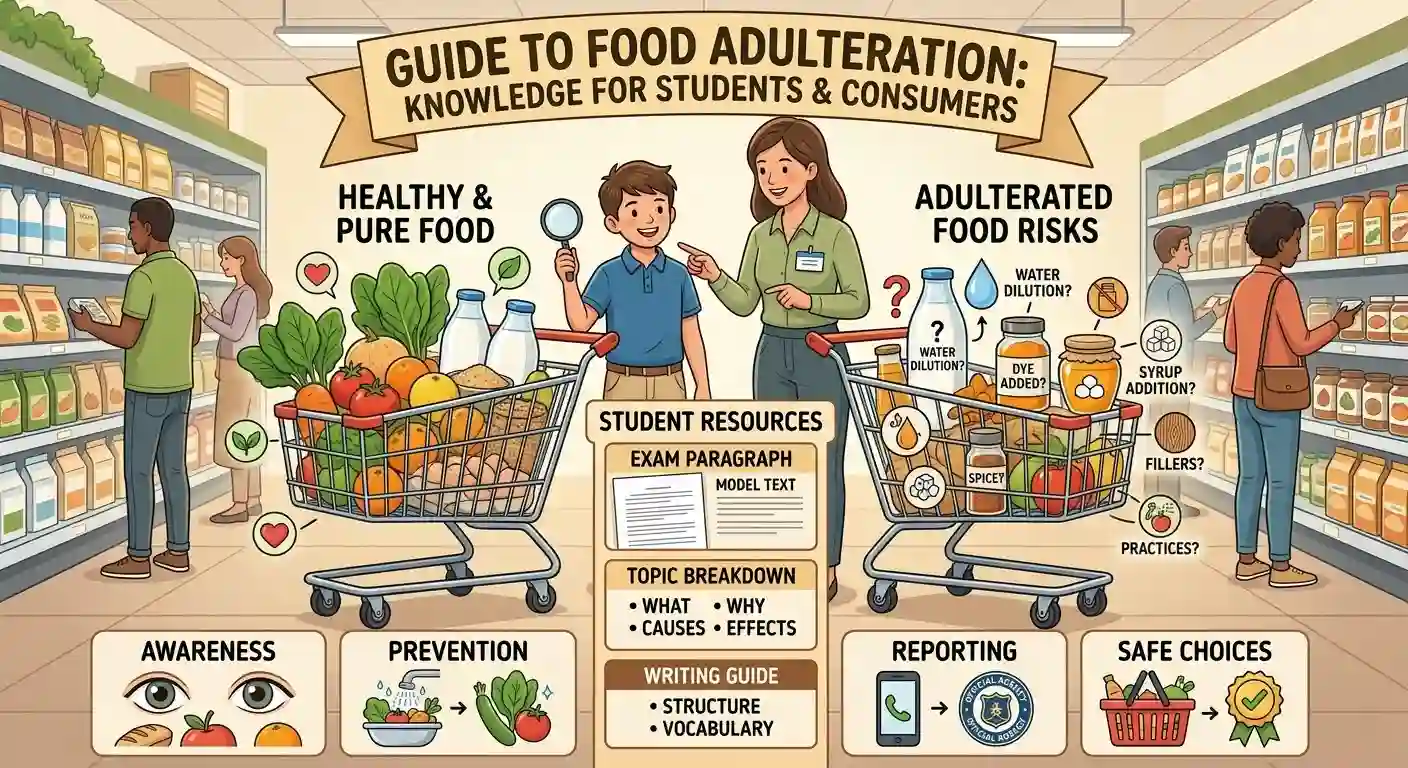
Ground spices provide another useful example. Because consumers cannot easily see the original ingredients after a product has been powdered, substitution or the addition of undeclared fillers may be difficult to notice. Unauthorized colors can also create misleading visual impressions. These practices can reduce consumer confidence and may create safety concerns when inappropriate substances are used.
Honey may be affected by the addition of inexpensive sweeteners or by inaccurate labeling. The important point for students is that adulteration does not always mean that a product becomes visibly dirty or dangerous. Sometimes the central issue is that the product does not match what the consumer was led to believe they were buying.
When writing a food adulteration paragraph, two or three accurate examples are usually more effective than a long list of dramatic claims. Clear examples make the writing easier to understand and reduce the risk of including questionable information.
Types and Forms of Food Adulteration
There is no single classification system used everywhere, and textbooks may organize the topic differently. For general educational purposes, food-quality problems can be understood through several broad forms.
1. Dilution
Dilution happens when another substance is added to a food or beverage, reducing the concentration of the original product. Water added to a liquid food is a simple example. If the added material is safe but undeclared and changes the product’s expected composition, it can still mislead consumers.
2. Substitution
Substitution occurs when one ingredient is replaced partly or completely with another ingredient. A cheaper material may be used in place of a more valuable ingredient without appropriate disclosure. This can affect nutritional composition, taste, quality, and the accuracy of product labeling.
3. Addition of Unauthorized Substances
Some products may be altered through the addition of colors, fillers, chemicals, or other substances that are not permitted for the intended food use. Whether a substance is legally allowed depends on the relevant food-safety regulations and its concentration. Students should therefore avoid making broad statements that every artificial ingredient is dangerous.
4. Removal or Reduction of Valuable Components
Food quality can also be compromised when an important component is removed or reduced and the change is not properly communicated to the consumer. The result may be a product that looks similar to the original but has a different nutritional or commercial value.
5. Contamination During Handling
Not every food-safety problem is deliberate. Food can become contaminated during harvesting, processing, transportation, storage, preparation, or serving. Microorganisms, foreign materials, chemicals, and allergens can enter food when proper controls are not maintained.
Understanding these distinctions makes a food adulteration paragraph more accurate because it prevents students from treating all food-safety problems as identical.
Health Effects of Adulterated or Contaminated Food
The health effects of unsafe food depend greatly on what is present in the food, how much is consumed, and how often exposure occurs. It is therefore inaccurate to suggest that every adulterated food causes the same illness. Some problems may cause no immediate symptoms, while contamination with certain microorganisms or harmful substances can result in significant illness.
Foodborne infections can cause symptoms such as nausea, vomiting, abdominal discomfort, diarrhea, and fever. The severity can vary according to the organism involved and the health of the individual. Young children, older adults, pregnant people, and individuals with certain health conditions may be more vulnerable to some foodborne illnesses.
Chemical contaminants present a different type of concern. Certain substances can be harmful when exposure is sufficiently high or repeated over time. Heavy metals, for example, can have serious effects on human health, but the risk depends on the particular metal and the level and duration of exposure. It is therefore better to discuss such risks carefully rather than claiming that every trace of every chemical will cause organ damage.
For an academic food adulteration paragraph, students should use responsible language such as “may increase the risk,” “can cause,” or “depending on the level of exposure” when discussing health effects. This makes the writing more scientifically responsible.
How Food Adulteration Can Affect Students and Children
Students need nutritious and safe food because adequate nutrition supports normal growth, learning, and daily activity. Unsafe food can cause short-term illness that may interfere with school attendance and concentration. If poor-quality food repeatedly replaces nutritious meals, the overall diet may also become less balanced.
Children can be particularly vulnerable to some contaminants because their bodies are still developing. However, the exact health effect depends on the contaminant and the amount of exposure. For this reason, parents, schools, food sellers, and authorities all have a role in maintaining safe food environments.
For students studying English, the topic also provides an opportunity to connect academic writing with everyday life. A well-organized food adulteration paragraph can explain not only what the problem is but also why young people should care about food quality.
How to Recognize Possible Food-Safety Problems
Consumers can observe certain warning signs when shopping, but appearance alone cannot confirm adulteration. Unusual color, strange odor, damaged packaging, leakage, incorrect labeling, broken seals, or an unexpected texture may justify caution. These signs should be treated as reasons to avoid a questionable product or seek reliable information, not as proof that a particular substance has been added.
Home experiments found on social media should also be approached carefully. Many popular tests for milk, honey, spices, or oils are not reliable enough to identify specific adulterants. Confirming the presence and concentration of many contaminants requires appropriate laboratory methods.
This distinction is important because an unreliable home test may create unnecessary fear or give consumers false confidence. If serious contamination is suspected, the safer approach is to avoid consuming the questionable product and contact an appropriate food-safety authority or qualified laboratory where available.
Safe Ways to Reduce the Risk
Consumers cannot personally test every item they purchase, but practical food-safety habits can reduce unnecessary risks.
- Choose reputable sellers: Purchase food from businesses that have a good reputation for quality and proper handling.
- Check packaging: Look for intact seals, clear labels, dates, ingredient information, and appropriate storage instructions.
- Prefer traceable products: Products with identifiable manufacturers and reliable distribution channels can be easier to verify.
- Wash fresh produce: Clean fruits and vegetables thoroughly under clean running water before eating or preparing them.
- Store food correctly: Follow refrigeration and storage instructions and avoid leaving perishable food at unsafe temperatures.
- Separate raw and ready-to-eat foods: This helps reduce cross-contamination during food preparation.
- Be cautious with suspiciously cheap products: An unusually low price does not prove adulteration, but it can be a reason to examine quality and labeling more carefully.
- Report serious concerns: When a product appears unsafe or misleading, consumers can contact the relevant food-safety or consumer-protection authority.
These measures focus on practical risk reduction rather than unverified household detection methods. They can also give students realistic solutions to include in a food adulteration paragraph.
Role of Consumers in Preventing Food Adulteration
Consumers have an important role because purchasing decisions influence the market. When buyers consistently prefer transparent, properly labeled, and reputable products, businesses have stronger incentives to maintain quality. Consumer awareness also makes it easier for people to identify misleading packaging and report suspected violations.
Consumers should avoid spreading unverified claims on social media. A photograph of unusual food does not automatically prove adulteration, and accusing a particular business without reliable evidence can unfairly damage its reputation. Responsible reporting is more useful than online speculation.
Education is another powerful tool. Families can teach children how to read labels, check packaging, store food safely, and maintain good hygiene. These simple habits create a practical foundation for understanding food safety beyond the classroom.
Role of Food Producers and Sellers
Food businesses carry significant responsibility because they control many stages between production and consumption. Producers should use suitable raw materials, maintain hygienic facilities, follow applicable regulations, and keep accurate records. Food processors should also have appropriate quality-control procedures for identifying problems before products reach consumers.
Sellers have responsibilities too. They should store food according to the manufacturer’s instructions, avoid selling damaged or expired products, and provide accurate information to customers. Honest labeling is especially important because consumers depend on it when deciding what to purchase.
Businesses that maintain transparent practices can build long-term trust. Food safety should not be treated merely as a legal requirement; it is also an important part of ethical business conduct.
Role of Government and Food-Safety Authorities
Individual consumers cannot solve food adulteration alone. Effective food-safety systems require clear standards, inspections, laboratory capacity, enforcement, and public education. Authorities can establish requirements for food production, labeling, storage, transportation, and sale.
Regular inspections can help identify businesses that fail to follow applicable standards. Where violations are confirmed, authorities can use the penalties and corrective measures provided by law. Depending on the legal framework, these measures may include warnings, fines, product recalls, suspension of operations, or other enforcement actions.
Governments can also invest in testing facilities and awareness campaigns. When consumers know where to report suspected problems and businesses understand their obligations, the overall food-safety system becomes stronger.
Food Adulteration and Public Health
Food safety is closely connected with public health because large numbers of people depend on the same supply chains. A problem involving a widely distributed product can affect many households at once. Preventing contamination and fraudulent practices is therefore more efficient than responding only after people become sick.
Strong food-safety systems also support economic stability. Businesses benefit from consumer trust, while families benefit when avoidable food-related illnesses and unnecessary expenses are reduced. Public awareness, responsible business practices, and effective regulation work together rather than functioning as separate solutions.
These broader connections can make a food adulteration paragraph more thoughtful because students can show that food quality is not only a personal issue but also a matter of public responsibility.
Food Adulteration Paragraph for Students
Students often need a model paragraph that is concise enough for an examination but detailed enough to cover the main points. The following example is written in simple, formal English and can be adapted rather than memorized word for word.
Food adulteration is the practice of reducing the quality or purity of food by adding unauthorized substances, replacing valuable ingredients with cheaper materials, or otherwise changing a product without proper disclosure. It may happen because of the desire for higher profit, weak quality control, poor storage, or inadequate food-safety practices. Milk may be diluted, spices may contain undeclared fillers, and some products may be incorrectly labeled or colored. Unsafe food can reduce nutritional value and, depending on the contaminant and level of exposure, may create health risks. Children and students need particular attention because safe and nutritious food supports healthy growth and learning. Preventing the problem requires responsible food businesses, effective government inspection, reliable testing, accurate labeling, and informed consumers. Everyone has a role in promoting a safer food supply.
Short Food Adulteration Paragraph
For a short-answer examination, students may need to explain the topic in only a few sentences. A concise answer should still contain a definition, one or two examples, the possible consequences, and a solution.
Food adulteration means changing the quality or purity of food by adding unwanted substances, diluting products, or replacing valuable ingredients with cheaper materials. Milk, spices, oils, and other common foods may be affected by such practices or by poor handling. Unsafe food can reduce nutritional value and may cause health problems depending on the type and amount of contamination. Strict food-safety rules, proper inspections, responsible businesses, and aware consumers are important for reducing this problem.
Food Adulteration Paragraph for School Exams
A school examination answer should be simple, organized, and grammatically correct. Students do not need to use complicated scientific terminology to earn good marks. A clear explanation with relevant examples is usually more effective than a collection of difficult words.
Food adulteration is a serious social and public-health issue. It occurs when the quality or purity of food is intentionally or unintentionally compromised. Dishonest traders may dilute products, replace expensive ingredients with cheaper ones, or use substances that are not appropriate for the intended food. Poor hygiene, unsafe storage, and contamination during transportation can also affect food quality. Eating unsafe food may cause illness and may reduce the nutritional value of daily meals. To control the problem, food authorities should enforce safety standards, businesses should follow proper hygiene and labeling rules, and consumers should buy food from trustworthy sources. Public awareness is also necessary to create a safer and more responsible food system.
How to Write a Good Paragraph About Food Adulteration
Writing a strong academic paragraph becomes easier when students organize their ideas before beginning. A simple structure can prevent repetition and help the answer remain focused.
- Start with a definition: Explain what the topic means in one or two clear sentences.
- Introduce the causes: Mention economic pressure, poor quality control, weak monitoring, or other relevant causes.
- Add examples: Use two or three familiar examples instead of creating a long list.
- Explain the consequences: Discuss nutritional loss, consumer deception, or potential health risks carefully.
- Offer solutions: Mention responsible businesses, government oversight, testing, labeling, and consumer awareness.
- Finish with a strong closing idea: End by emphasizing the importance of cooperation and food safety.
When students follow this structure, a food adulteration paragraph becomes easier to organize and less likely to sound like a collection of unrelated facts.
Common Mistakes Students Should Avoid
Many students make avoidable mistakes when writing about social issues. One common problem is repeating the definition several times. Another is using too many examples without explaining why they matter. A third problem is making dramatic health claims without considering whether the information is scientifically supported.
Students should also avoid writing that every artificial ingredient is poisonous. Some food additives are legally permitted and are used safely when applied according to relevant standards. The problem is more accurately described as the use of unauthorized, inappropriate, misleading, or unsafe substances and practices.
Another mistake is presenting household tests as definitive scientific methods. A visual observation may raise suspicion, but laboratory analysis is often necessary to identify a particular adulterant with confidence. Including this distinction can make academic writing more accurate and mature.
Why Consumer Awareness Matters
Consumer awareness is one of the most practical ways to improve food safety. An informed buyer is more likely to read labels, check packaging, consider storage conditions, and choose established sources. Awareness also discourages the spread of unsupported rumors about particular foods or businesses.
Schools can contribute by teaching students basic food-safety principles. Lessons about nutrition, hygiene, labeling, and responsible consumption can turn an examination topic into useful everyday knowledge. Parents can reinforce these habits at home by involving children in safe food selection and preparation.
Frequently Asked Questions
What is food adulteration?
It is the alteration or compromise of food quality, purity, identity, or composition through practices such as dilution, substitution, addition of inappropriate substances, or other forms of contamination. The exact legal meaning can vary by jurisdiction.
Why is food adulteration harmful?
It can reduce expected nutritional quality, mislead consumers, and, in some circumstances, expose people to harmful biological or chemical contaminants. The actual health risk depends on the substance and level of exposure.
What are common examples?
Examples used in educational discussions include dilution of milk, substitution of valuable ingredients, undeclared fillers in powdered foods, and misleading product composition or labeling.
What causes the problem?
Possible causes include financial incentives, inadequate quality control, poor storage, weak monitoring, insufficient consumer awareness, and contamination during production or transportation.
Can consumers identify adulteration at home?
Consumers may notice warning signs such as damaged packaging, unusual appearance, or unexpected odor, but household observations cannot reliably confirm most forms of adulteration. Laboratory testing may be necessary for a definitive result.
How can students write a strong answer?
A strong answer should define the topic, explain its causes, provide a few relevant examples, describe possible consequences, and suggest practical solutions. Clear grammar and logical organization are more important than using unnecessarily difficult vocabulary.
Why should students learn about food safety?
Food safety is relevant to everyday life, and learning about it also gives students useful material for English writing, science, social studies, and general awareness.
What should be included in a food adulteration paragraph?
A good food adulteration paragraph can include a definition, causes, examples, possible effects, and prevention measures. The information should be presented logically and in language appropriate to the student’s level.
Is every contaminated food intentionally adulterated?
No. Food may become contaminated accidentally through poor hygiene, unsafe storage, agricultural exposure, processing errors, transportation problems, or cross-contamination. Intentional adulteration is only one category of food-quality concern.
Conclusion
Food adulteration is an important educational topic because it connects food quality with consumer rights, public health, business ethics, and personal responsibility. The problem can involve deliberate economic practices, inaccurate labeling, ingredient substitution, or contamination caused by poor handling. Because the causes are different, solutions must also operate at several levels.
Consumers can make careful purchasing decisions and report genuine concerns. Food businesses can maintain proper hygiene, accurate labeling, quality control, and traceable supply chains. Authorities can establish and enforce appropriate standards while providing reliable testing and public education. Together, these measures can contribute to a safer food environment.
For students, the topic provides an excellent opportunity to practice clear English while learning about an issue that affects everyday life. Instead of memorizing a fixed answer, learners should understand the main ideas and then express them in their own words. A thoughtful food adulteration paragraph should be accurate, organized, and easy to understand. With the right structure and responsible use of facts, students can produce strong examination answers while developing useful knowledge about food safety and consumer awareness.